Medicaid cuts could push more kids into caregiving roles, putting their mental health, education, and future well-being at risk.
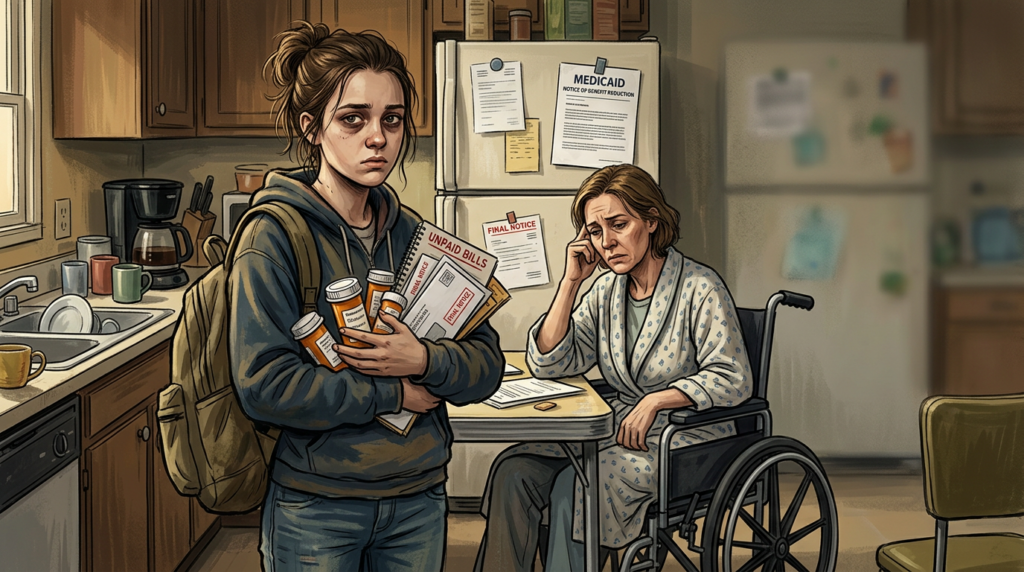
Across the U.S., a quiet but serious issue is growing—one that rarely makes headlines in a meaningful way. While most conversations about caregiving focus on adults caring for aging parents, there’s a largely invisible group carrying a heavy burden: children.
And new policy changes could make that burden much worse.
Recent proposals to cut Medicaid funding—particularly for home-based care services—are raising concerns that more children may be pushed into caregiving roles inside their own homes. This isn’t just about helping out occasionally. We’re talking about kids managing medications, assisting with mobility, handling finances, and acting as emotional anchors for seriously ill or disabled family members.
Let’s break down what’s actually happening, why it matters, and what’s missing from the conversation.
The Core Issue: Medicaid Cuts and Care Shifts
Medicaid plays a major role in funding long-term care in the United States, especially for low-income families. One of its most critical components is Home and Community-Based Services (HCBS), which enables patients to receive care at home rather than in institutions.
When those services are reduced or eliminated, the care doesn’t disappear—it shifts.
And often, it shifts onto family members.
In households without financial flexibility, that responsibility frequently falls on whoever is available. Many times, that’s a child.
According to national estimates, over 5.4 million children in the U.S. already serve as caregivers. These are not edge cases. This is a widespread but underrecognized reality.
What Young Caregivers Actually Do
The term “caregiver” might sound vague, but in practice, these kids are doing highly demanding work. This can include:
- Assisting with bathing, dressing, and feeding
- Managing medications and medical appointments
- Helping with mobility and physical support
- Handling household responsibilities like cooking and bills
- Providing emotional support during chronic illness or recovery
This level of responsibility fundamentally changes a child’s development. It compresses childhood into something much more adult—and much more stressful.
The Mental Health Impact
Research consistently shows that young caregivers face significantly higher risks of:
- Anxiety and chronic stress
- Depression
- Substance use issues
- Sleep disruption
- Long-term emotional and relational challenges
This isn’t just short-term strain. Many carry these effects into adulthood, impacting careers, relationships, and overall well-being.
A key issue here is that these children are often invisible. They don’t identify as caregivers. Schools don’t track them. Healthcare systems rarely account for them.
So the burden continues quietly.
Why Medicaid Cuts Could Worsen the Problem
Here’s the chain reaction the article is pointing to:
- Medicaid funding decreases
- Fewer in-home care services are available
- Families lose professional support
- Care responsibilities shift to the household
- Children step in to fill the gap
This isn’t guaranteed in every case, but it becomes more likely—especially in low-income households with limited alternatives.
If even a fraction of the estimated 11.8 million people at risk of losing coverage lose access to home care, the downstream effect could be substantial.
What the Article Gets Right
The piece does a strong job of highlighting:
- The scale of youth caregiving in the U.S.
- The emotional and psychological toll
- The lack of visibility in policy discussions
- The connection between healthcare access and family burden
It also uses personal stories effectively to illustrate what this looks like in real life, helping ground the policy discussion.
What It Leaves Out
At the same time, the article is clearly written from an advocacy perspective, and there are gaps worth noting:
- It doesn’t break down the specifics of the Medicaid cuts in detail
- It assumes a strong causal link without quantifying projected increases in child caregivers
- It doesn’t explore alternative support systems (extended family, nonprofits, state-level programs)
- It leaves out arguments from policymakers who support the cuts
- It doesn’t differentiate between levels of caregiving intensity
These omissions don’t invalidate the concern—but they do mean the full picture is more complex than presented.
The Bigger Structural Problem
Even without new cuts, the U.S. already has a caregiving infrastructure issue.
We rely heavily on unpaid labor to sustain long-term care. When formal systems fall short, families absorb the cost—financially, emotionally, and physically.
Children becoming caregivers is not a new problem. What’s changing is the potential scale.
And scale is what turns a social issue into a systemic crisis.
What Could Help
There are solutions—but they require recognition first.
Some potential approaches include:
- Expanding Medicaid HCBS funding rather than cutting it
- Creating formal identification systems for young caregivers in schools and healthcare settings
- Providing mental health services specifically for caregiving youth
- Offering respite care to reduce the continuous burden
- Developing policy protections similar to those in countries like the UK
In the UK, for example, young caregivers are legally recognized and supported through targeted programs. The U.S. has nothing comparable at a national level.
Why This Matters Now
Policy decisions made today don’t just affect healthcare access—they reshape family dynamics.
If support systems shrink, responsibility doesn’t disappear. It redistributes.
And without safeguards, it redistributes downward—to the youngest and least equipped members of the household.
That’s the core warning here.
Not that every Medicaid cut will directly create child caregivers, but the risk is real, and largely unaccounted for.
Key Takeaways
- Millions of children in the U.S. already act as caregivers
- Medicaid cuts could reduce access to in-home care services
- Reduced services may shift caregiving responsibilities to families
- Children are often the default fallback in resource-strapped households
- Youth caregiving is linked to long-term mental health risks
- The issue is largely invisible in policy and public discourse
- Current discussions lack detailed projections and balanced policy analysis
FAQ
What is a young caregiver?
A young caregiver is a child or teenager who provides regular care for a family member with illness, disability, or other health needs. This can range from basic help to complex medical support.
How common is this in the U.S.?
Estimates suggest over 5.4 million children are involved in caregiving roles, though the number may be higher due to underreporting.
What are HCBS services?
Home and Community-Based Services (HCBS) are Medicaid-funded programs that provide care in a person’s home instead of a hospital or nursing facility. This includes nursing care, therapy, and daily living support.
Why would Medicaid cuts affect children?
If professional care becomes unavailable or unaffordable, families must fill the gap. In many cases, children help meet those needs—especially in single-parent or low-income households.
Is there proof that cuts will increase child caregivers?
There’s a strong logical link, but limited precise data predicting how many additional children would be affected. This is one of the key uncertainties.
Are there protections for young caregivers?
In the U.S., protections are minimal and inconsistent. Some nonprofits offer support, but there is no comprehensive national policy. Other countries, like the UK, have more formal systems in place.
Can families avoid this situation?
Some can, through private care, extended family support, or community resources. However, these options are not equally available to all households.
Leave a Reply